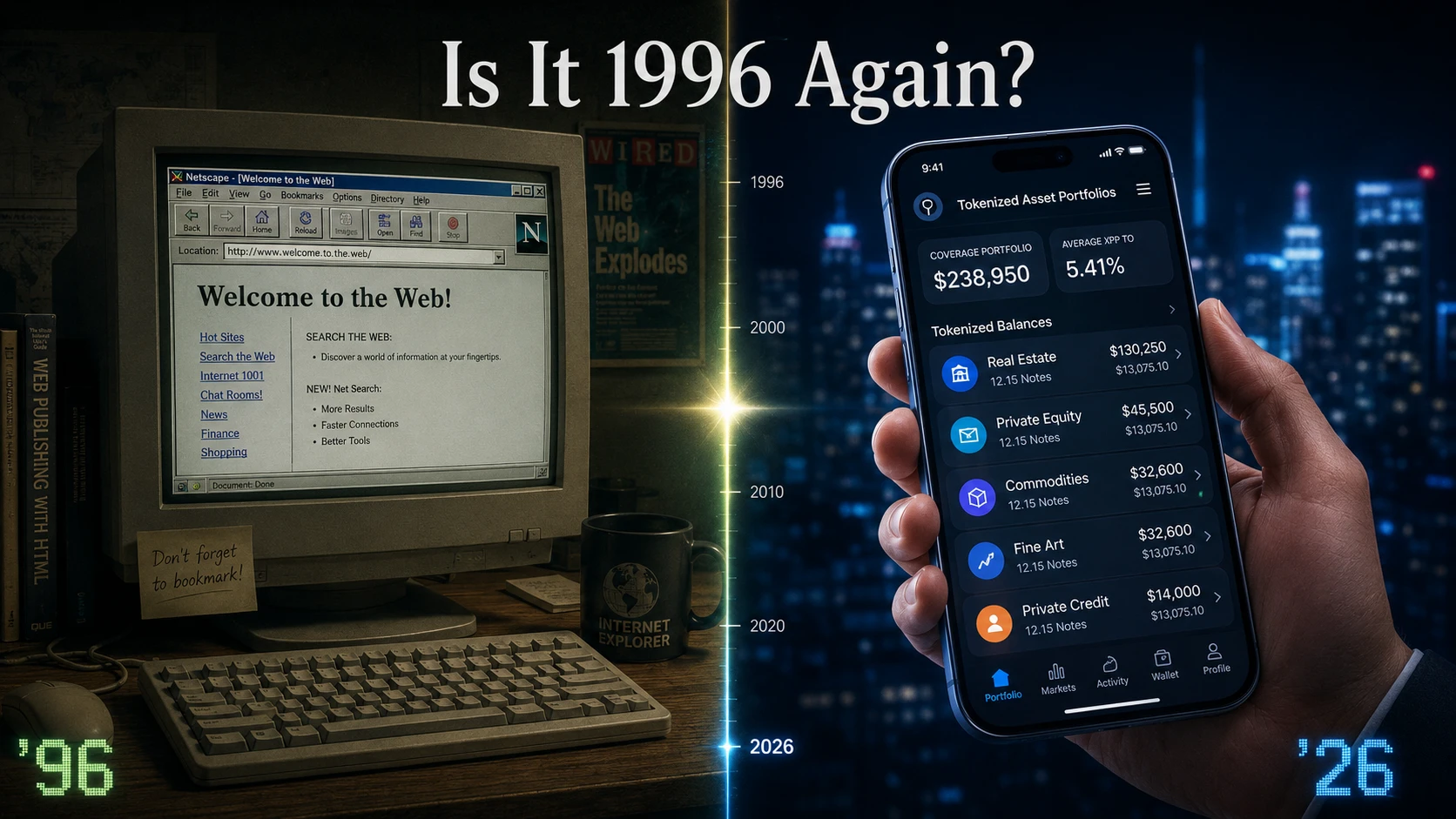
Are we in 1996 again?
Who used the flying DeLorean?
In his 2026 Chairman's Letter, BlackRock CEO Fink wrote that tokenization is roughly where the internet was in 1996 (BlackRock, 2026). BlackRock now has nearly $150Bn in assets connected to digital markets. The on-chain real-world asset market has reached $26Bn, up about 300% in a year, with private credit alone accounting for $14Bn of that (PYMNTS, April 2026).
These are real hard numbers. The infrastructure is being built, the institutional interest is real, and Fink isn't the type to use major annual letters to idly speculate.
But 1996 also means we were three years away from the dot-com crash back then. The companies that survived that quake, Amazon (founded 1994), Google (incorporated 1998), became essential. Many of the most highly priced (and prized) names from 1996 vanished entirely (eToys, Pets.com, Webvan, Kozmo.com...).
The 1996 analogy is accurate. That's exactly what makes it unsettling. You can watch the same misallocation impulse in real time in the prediction-market boom, which I wrote about in The Biggest Bet in History Was a Football Match.
What 1996 Actually Looked Like
It's easy to look back at 1996 and see the internet as inevitable. From here, it was.
But at the time, most enterprise technology executives (serious, experienced people) thought the internet was a fad. Or a toy. Or something their nephew was interested in. Netscape had just gone public in August 1995 in one of the most dramatic IPOs in history. Amazon was selling books and only books, operating out of a garage in Bellevue, Washington. AOL was still mailing floppy disks to households. Dial-up was the norm, you waited several seconds to load a page, the connection would drop, and you'd start again.
The infrastructure for what the internet would become, broadband, cloud computing, ubiquitous smartphones, didn't exist yet. What existed was the proof that the use case was real, accompanied by genuine uncertainty about which specific implementations would survive.
The parallel to tokenization today is precise and uncomfortable.
The use case is real. The infrastructure is forming. Distribution channels are still very narrow. Most institutional participants are either skeptical or cautious, not because they're wrong to be cautious, but because the 1996 internet was also genuinely risky to bet on with large capital.
What's Actually in the $26Bn RWA Market
The on-chain real-world asset number deserves unpacking, because it gets treated as a single data point when it's actually several different stories.
Private credit is the largest category at $14Bn, institutional lending tokenized on-chain, allowing investors to hold and transfer credit positions that previously required complex legal structures and illiquid secondary markets. This is a genuine structural improvement. The underlying asset (private credit) is inherently illiquid, slow to settle, and expensive to access. Tokenization makes it more accessible without changing what it is.
US Treasury tokenization is the next largest story. BlackRock's BUIDL fund and Franklin OnChain's FOBXX are government money market funds running on public blockchains. The asset is maximally liquid already, so the gain here isn't liquidity, it's composability. A tokenized T-bill can be used as collateral in a DeFi protocol, or settled as part of an on-chain transaction, in ways that a traditional T-bill can't. That's a real, if different, improvement.
Trade finance, real estate, and commodities round out the picture, each at earlier stages, each with different structural benefits from tokenization.
The point is, the $26Bn isn't homogeneous. It's multiple use cases at multiple stages of maturity. Some of these will scale dramatically. Others will plateau. And we don't know yet which is which, which is exactly Fink's point.
What the $150Bn BlackRock Number Actually Means
It's worth being precise about what BlackRock's $150Bn figure represents, because it gets cited loosely.
It's not $150Bn in tokenized assets. It's assets connected to digital market infrastructure, which includes investments in crypto ETFs, positions in digital asset companies, exposure to blockchain infrastructure plays, and tokenized fund products. The positioning is real and significant. The scaling is still early.
This distinction matters because it tells you something about where even the most sophisticated institutional players actually are. BlackRock is the world's largest asset manager, they have more resources and analytical firepower than almost any firm on the planet, and their $150Bn is mostly exposure to the category rather than deep operational integration with the infrastructure.
If BlackRock is still mostly in positioning mode, the industry is earlier than the headline number implies. Fink knows this. The 1996 framing is his way of saying, the direction is right, the timing is genuinely uncertain, be careful about mistaking momentum for maturity.
The Selection Problem, Amazon vs. Pets.com
If you read Fink's letter carefully, he is saying that the tokenization use case is real and the infrastructure is forming, but the distance between where we are and where this goes is still unknown. That is a different statement from "everything tokenized wins."
So how do you identify the Amazon vs. the Pets.com in tokenization?
Here's my analytical take, it's not the asset being tokenized that matters most. It's the structural inefficiency that tokenization actually eliminates.
Amazon didn't win because it sold things online. It won because online distribution eliminated the cost of physical inventory, storefronts, and geographic limitation for product selection. The internet wasn't the product. The structural improvement to retail economics was the product. The internet was the mechanism.
Pets.com sold pet food online and shipped it to your door. The problem, pet food is heavy, low-margin, and widely available locally. There was no structural efficiency being unlocked. The internet was just a different order-taking mechanism for a product that didn't benefit from it.
The tokenization projects that survive will have to demonstrate the same logic. Assets that are currently illiquid, slow to settle, or expensive to access, private credit, certain trade finance instruments, real estate in markets without deep secondary liquidity, are clear candidates. Cross-chain bridge infrastructure is a useful case study here, the technology was real and the use case was genuine, but the concentration risk was invisible until it wasn't. The structural improvement is real and measurable. On the derivatives side, Coinbase's perpetual equity futures on a CFTC-regulated exchange is another illustration of the same dynamic, a crypto-native market structure arriving on regulated rails after a decade of proving itself offshore.
Assets that are already efficiently traded, major equities, liquid government bonds, large-cap FX, probably gain less. Tokenizing a US Treasury doesn't make it more liquid. It was already liquid. What it adds is composability, which is real but narrower in its immediate impact.
The Pets.com of tokenization would be a project that tokenizes an already-efficient asset and calls the added complexity a feature. I think we'll see several of those. Some will raise a lot of money. Most won't survive 2029.
The Uncomfortable Part
The 1996 analogy is useful framing. It explains both why the opportunity is large and why picking the right bet is genuinely difficult. Those two things don't conflict. They are the same.
It says nothing about market structure, though, and market structure tends to get settled early and quietly. How crypto decided to handle transaction ordering is one of those decisions, made in engineering rather than in policy, and it will outlast most of the projects competing for the headline.
However, the uncomfortable part of the 1996 analogy? It's also a reminder that most capital will still be misallocated before the winners emerge.
In the dot-com era, serious institutional investors backed serious-looking companies that didn't survive. The failure wasn't always naivety. Sometimes it was timing, the right use case but the wrong moment. Sometimes it was infrastructure, the product was real but the underlying connectivity couldn't support it yet. Sometimes it was the classic mistake of confusing a feature with a business.
We should expect the same distribution of outcomes in tokenization. Some of the most credible-looking projects, backed by the most impressive syndicates, will not make it. And some of what looks like a niche experiment today will turn out to be load-bearing infrastructure in five years. The AI agent payment layer is one candidate to watch closely, the use case exists, the infrastructure is forming, and TradFi has no framework for it yet.
Bubble anyone?
I don't think we're at the peak of the bubble yet, if that's where this goes. 1996 wasn't the peak, 1999 was. The exuberance was still building in 1996. If the analogy holds, we have some road to run before the reckoning. But the reckoning is part of the script too.
We have run this reel before. We know how the third act goes.
