Most resources for learning DeFi are built for developers or speculative retail investors: not for people who understand balance sheets, risk committees, and regulatory frameworks. These tools are built differently. They start from the assumption that you already know how finance works and translate blockchain mechanics into concepts you can anchor to your existing knowledge: liquidity pools explained through market-making parallels, protocol risk framed as a variant of counterparty risk, yield calculation presented the way a fixed-income analyst would approach it.
Each tool has been built from first principles and validated against 30+ years of institutional experience across TradFi and crypto. The goal is not to make you a blockchain developer. It is to make you effective in a boardroom conversation about digital assets, able to ask the right questions and recognize an incomplete answer.
DeFi Primer
The fastest way for finance professionals to build a working mental model of decentralised finance, without the jargon or the Twitter rabbit holes. This interactive guide covers how DEXs actually clear trades and why they replace an order book with a liquidity pool, how AMMs generate yield and what impermanent loss actually costs you, how cross-chain bridges move assets and where their failure modes concentrate, and what the most significant protocol incidents since 2020 tell us about on-chain risk. Live data is pulled from DeFiLlama throughout, so the TVL numbers and yield figures you're looking at are current, not illustrative snapshots. If you can analyse a CDO, you can learn DeFi. But you need a framework built for your background, not for a developer audience.
Last updated 24 October 2026 · Last verified 24 October 2026
Open Interactive Tool →
DeFi Glossary
106 core DeFi and Web3 terms defined in plain English for finance professionals. Not a developer glossary: every definition starts from the institutional finance perspective and flags where the standard analogy breaks down. Covers AMMs, flash loans, restaking, oracles, MEV, private keys, rollups, RWAs, and more — with internal links to deeper analysis where relevant.
Last updated 17 October 2026 · Last verified 17 October 2026
Open Interactive Tool →
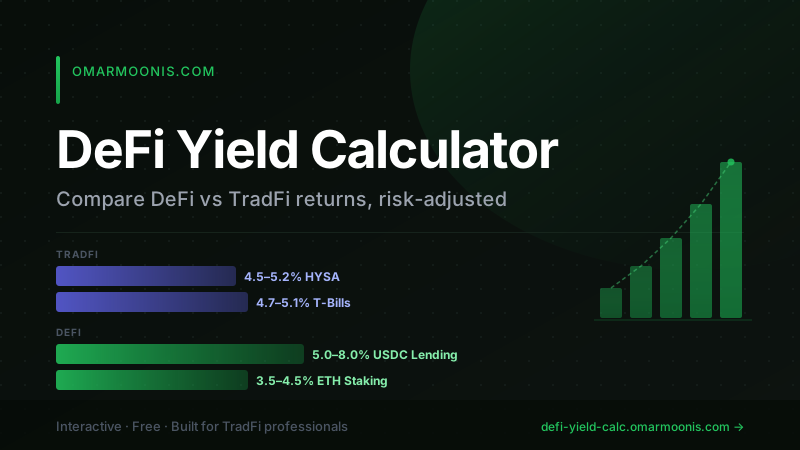
DeFi Yield Calculator
Before any investment committee considers a DeFi allocation, it needs answers to one question: is the extra yield worth the extra risk? This calculator provides a framework to find out. Enter your investment amount and select a risk appetite (conservative, moderate, or aggressive) and it maps current DeFi protocol yields against T-bills, high-yield savings accounts, and corporate bonds in a side-by-side comparison. Each option includes a plain-English breakdown of what the incremental return requires you to accept: smart contract exposure, liquidity risk, token price volatility, or protocol governance risk. Built for CFOs, family offices, and investment advisors who need to present a crypto allocation to an investment committee, not justify it to themselves.
Last updated 24 October 2026 · Last verified 24 October 2026
Open Interactive Tool →
Blockchain Whitepapers
Every major blockchain began as a document making an argument, and reading that argument in the original tells you more than any summary can. This library collects the founding whitepapers of 11 of the most-traded blockchains with a whitepaper, a dated snapshot rather than a live ranking, from Satoshi Nakamoto's 9 pages to Sui's object model, each hosted as an archived PDF with a link to the canonical source. Every paper gets a plain-English briefing written from the institutional finance perspective, covering what it proposed, what a diligence reader should notice, and where the network diverged from its founding text. Includes a short guide to reading any whitepaper the way a risk committee would, plus a note on the heavily traded chains that never wrote one.
Last updated 17 October 2026 · Last verified 17 October 2026
Open Interactive Tool →
Self-Custody Risk Guide
Self-custody risk is one of the most consequential and least understood risk categories in digital assets, responsible for a significant share of the $3.4 billion stolen in 2025 and an estimated 20% of all Bitcoin permanently lost. This guide is built for risk officers, compliance professionals, and board members who need to understand what institutional self-custody risk actually is: not a technology problem, but a governance problem with technology dimensions. It covers the seven risk categories (private key management, smart contract vulnerabilities, operational error, regulatory compliance, inheritance and succession, network-level failures, and cybersecurity), four regulatory frameworks (FATF Travel Rule, MiCA, Basel III, SEC), five case studies from Mt. Gox to FTX, and an eight-step institutional framework. Every claim is verified against at least two independent sources. Written by a custody-risk practitioner with 30+ years in institutional finance.
Last updated 17 October 2026 · Last verified 18 October 2026
Open Interactive Tool →
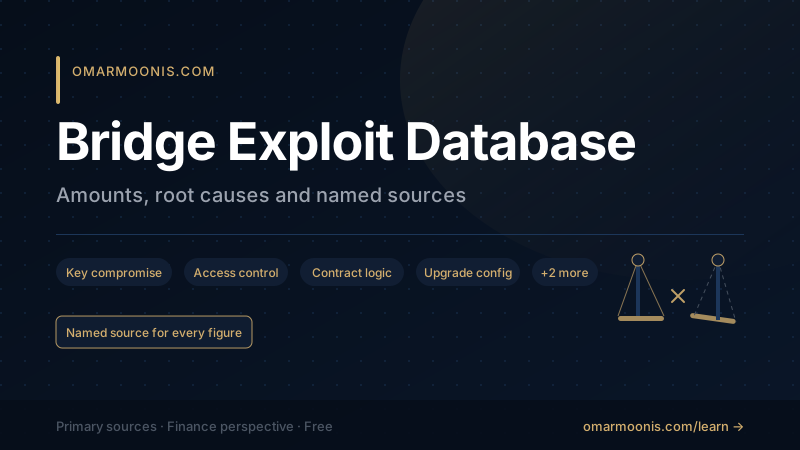
Bridge Exploit Database
Bridge failures get reported as smart contract failures. Many are, but by value the largest share of the losses is not. This database records major cross-chain bridge and cross-chain infrastructure exploits since 2021 with the amount lost, a single assigned root cause, and a named primary source for each figure, then classifies them so the pattern is visible. Measured in dollars, more was lost to authorization failures, where an attacker held the keys or reached a privileged function and the code ran exactly as written, than to the verification, logic and upgrade defects an audit is built to catch. Auditing the code harder would not have prevented those. Includes the methodology, what is deliberately excluded and why, and a citation block for anyone referencing the figures.
Last updated 17 October 2026 · Last verified 24 October 2026
Open Interactive Tool →
The TradFi Bridge Methodology
Every tool here starts from the same premise: the terminology of decentralized finance is genuinely foreign to most institutional finance professionals, but the underlying concepts are not. Liquidity pools have structural parallels in market-making operations. Lending protocols are built on the same collateralisation logic as repo markets. Smart contract risk is a form of counterparty risk with different failure modes, specifically the failure mode where the counterparty is not a party at all but a piece of code that cannot be sued.
The TradFi Bridge methodology translates each Web3 concept into its nearest institutional finance equivalent before explaining where the analogy breaks down. This creates a cognitive scaffold that lets experienced finance professionals build real understanding quickly, without the wrong intuitions that come from treating everything as entirely new, and without the oversimplifications that come from treating everything as entirely familiar.
If you work on self-custody risk specifically, the companion resource at Self-Custody Risk Guide covers institutional frameworks, regulatory obligations, and the case studies in depth.