When was the last time a group of banks banded together to help out a struggling bank?
Never happened?
Ok. Well, here's another TradFi/DeFi differentiator then.
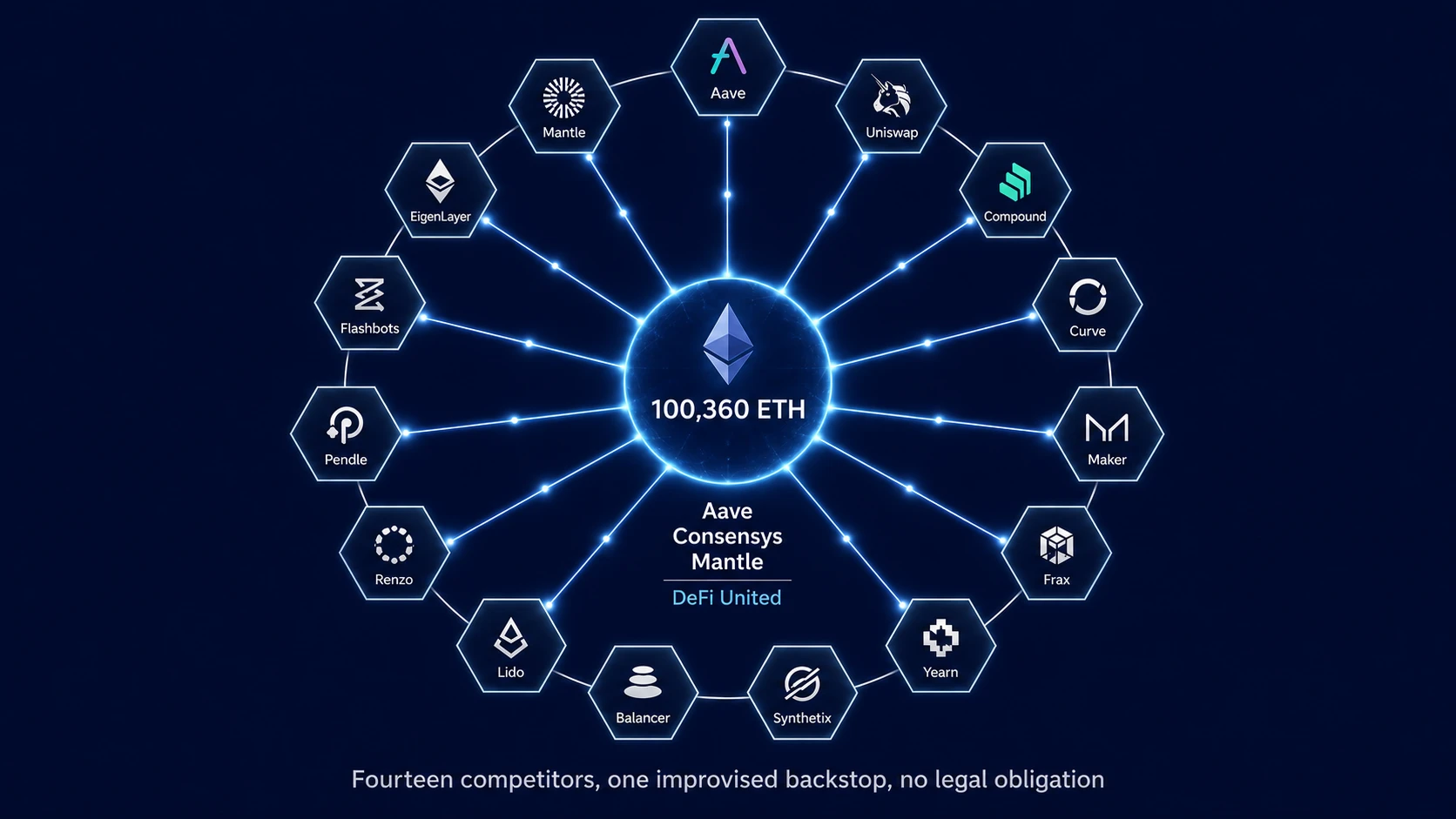
Ten days ago, a rescue operation assembled after DeFi's largest exploit of 2026 raised 69,618 ETH. By yesterday, it had crossed 100,360 ETH (roughly $238MM) from 14 contributing entities, none of whom had any legal obligation to participate.
To be clear. No central bank. No deposit guarantee scheme. No formal mandate. Fourteen protocols and individual contributors, some of them direct competitors, choosing to pool capital through an initiative called DeFi United to absorb the bad debt left by the Kelp DAO exploit less than two weeks ago (CryptoTimes, April 2026).
This structure, assembled by lending protocol Aave's service providers in the immediate aftermath of the exploit, is the closest thing DeFi has produced to a lender of last resort without a regulator, a central bank, or a formal legal mandate. It's a remarkable collaboration actually. Enough to bring tears of joy and validation for those of us in the space.
In any crisis, voluntary coordination among competing institutions is the unlikeliest and most improbable outcome. Central banks exist precisely because spontaneous coordination fails at scale.
What DeFi United demonstrates is that shared self-interest, when the stakes are high enough and the interdependence visible enough, can substitute for formal backstops. The contributors weren't saints, they were protecting their own protocol exposure.
Have we reached DeFi nirvana, though? The promised land of a self correcting, decentralized ecosystem?
Not yet. While extraordinary, we don't know if such collaborations can scale. Or, if the same collaborators show up six months from now to save a protocol with a different profile and fewer mutual dependencies.
The lender of last resort question in DeFi isn't resolved yet. It's deferred, at least this once.
What Actually Happened, The Kelp DAO Exploit
To understand why the response matters, you have to understand what it was responding to.
On April 18, 2026, Kelp DAO, a liquid restaking protocol, lost $292MM in 46 minutes. Hackers found a way to trick Kelp's minting mechanism into believing it had received ETH that didn't exist. The protocol dutifully minted 116,500 rsETH against that phantom collateral. The attackers swapped those tokens across multiple protocols and laundered the proceeds.
This was DeFi's largest exploit of 2026. And it left a specific, quantifiable hole in the system, 116,500 rsETH circulating across DeFi with no real collateral behind them. Those tokens didn't evaporate. They landed in lending protocols, liquidity pools, and collateral vaults. The damage didn't stay inside Kelp's perimeter. It radiated outward.
That radiation is what made DeFi United necessary. And what made it possible. For readers new to how lending protocols and collateral pools actually work, the DeFi Primer breaks it down in plain language.
How DeFi United Was Built
Here's where the timeline gets interesting.
Within days of the exploit, Aave's primary service providers, specifically the Aave Chan Initiative, started assembling a response. Not a committee. Not a working group pending a governance vote. An actual capital pool, designed to absorb the bad debt before it metastasized further.
Fourteen entities participated over two weeks. Some were direct Aave ecosystem contributors. Some were competitors. Some were individual contributors who simply showed up. The capital came in tranches, 69,618 ETH in the first ten days, crossing 100,360 ETH by the end of the second week. At that point, the pool had enough to cover the outstanding bad debt and stabilize the affected protocols.
The speed is what strikes me most. Two weeks from exploit to functional rescue pool. I've sat through regulatory crisis responses that took longer to convene the first call.
Why TradFi Would Never Do This Spontaneously
Let me be specific here, because "banks don't cooperate" is a lazy take that misses the real structural reason.
Banks are competitors for deposits, for lending margins, for fee income. If your competitor is struggling, helping them survive means helping them retain customers they might otherwise lose to you. The competitive incentive is literally to let them fail.
There's also regulatory structure working against it. Banks operate under frameworks, Basel III capital requirements, resolution mechanisms, deposit guarantee schemes, that are specifically designed around the assumption that voluntary coordination won't happen. The FDIC exists because regulators gave up expecting banks to rescue each other. It's not that regulators were pessimistic; it's that history proved them right.
The historical record is blunt on this. Barings Bank collapsed in 1995 after a single rogue trader accumulated catastrophic losses. No bank showed up voluntarily. Barings was declared insolvent and sold to ING for £1. LTCM in 1998 got closer, the Fed organized a consortium of 14 banks to inject $3.6Bn (Federal Reserve History, 2013), but it took Fed arm-twisting and explicit government facilitation to make it happen. "Spontaneous" was never in the vocabulary.
Tellingly, even the LTCM rescue was described at the time as unprecedented. And it required the threat of systemic collapse plus a central bank in the room making calls.
DeFi United required neither.
The Self-Interest Dynamic, Why It's More Interesting Than Altruism
The contributors to DeFi United weren't being altruistic. I want to be direct about that, because the narrative of protocols "coming together for the greater good" undersells what's actually more interesting.
DeFi protocols share infrastructure in a way that TradFi banks simply don't. rsETH circulates as collateral across Aave, Compound, and a dozen other lending protocols. The cross-chain bridge migrations that followed the KelpDAO exploit, totaling $4Bn, show the same shared infrastructure dependency at work, when you share the plumbing, you share the risk. If you're running one of those protocols and unbacked rsETH is sitting in your collateral pool, that's your problem too. The 14 contributors weren't rescuing Kelp. They were protecting their own TVL, their own users, their own protocol health.
Shared infrastructure creates shared incentives. That's the structural difference from TradFi, where siloed systems mean your competitor's collapse doesn't automatically become your problem.
This is actually a more durable basis for cooperation than goodwill. Goodwill fades. Self-interest is consistent.
The Bagehot Question
Walter Bagehot, the 19th-century economist who basically invented the playbook for central banking, had a famous prescription for financial crises, lend freely, at a high rate, against good collateral. The point was to provide liquidity to solvent institutions, not to bail out insolvent ones.
DeFi United did something structurally different. It didn't lend. It absorbed. The contributors pooled capital to cover bad debt directly, rather than providing emergency liquidity to Kelp as a functioning borrower. Kelp wasn't a functioning borrower. The collateral was already gone.
Neither approach is obviously superior. Bagehot's model assumes a temporarily illiquid but fundamentally solvent institution. That wasn't the situation here. DeFi United's model, collective absorption of realized losses, is actually closer to a deposit guarantee scheme than to a central bank facility. Except it assembled voluntarily in two weeks without a statutory mandate.
I'm genuinely uncertain whether this is a better model or just a different one. The Bagehot doctrine has 150 years of institutional testing behind it. DeFi United has one data point.
What This Doesn't Resolve
The Kelp exploit was, in many ways, a best-case scenario for voluntary coordination. The damage was specific and quantifiable. The bad debt was visible on-chain. The contributing entities had direct shared interest in the resolution. The ask was concrete, pool ETH to cover a defined hole.
Now imagine a stablecoin depeg. A governance attack with ambiguous liability. A crisis where the bad debt is harder to isolate and the user base doesn't overlap with potential contributors. Would the same 14 protocols show up? It is the same coordination question I put to Open USD's 140-partner stablecoin consortium, except there the rivals have to stay aligned not for one two-week rescue but permanently.
Or imagine a faster failure than any of these. A market where thousands of autonomous trading agents, trained on the same data, all sell into the same shock at the same millisecond. I've argued that synchronized AI agents are the next systemic risk DeFi hasn't priced, and a coordinated rescue that takes two weeks is little comfort against a crash that takes two seconds. Voluntary coordination is salvage. It works far better after a slow casualty than after a flash crash.
I don't know, and neither does anyone else. DeFi United worked because the conditions were favorable. The lender of last resort question isn't resolved. It's deferred, with one encouraging data point.
What It Means for the Regulatory Argument
Here's where it gets interesting for those of us watching the regulatory space.
Regulators have long justified central bank backstops, and the extensive regulatory infrastructure around them, by arguing that markets can't self-coordinate in a crisis. It's not an unfair argument. History supports it more often than not.
DeFi United is a data point against that assumption. A genuine, voluntary, cross-institutional capital pool that assembled in two weeks without a regulator in the room. That counts for something.
Whether regulators update their priors is a different question. Regulatory frameworks move slowly, and one successful voluntary rescue doesn't overturn decades of institutional memory about why central banks exist. But it does add something to the conversation, evidence that decentralized coordination can work, at least under the right conditions.
The more interesting outcome might be regulatory, if DeFi can demonstrate this pattern consistently, the argument for applying TradFi-style mandatory backstop requirements to DeFi becomes harder to sustain. That's a thesis worth watching.
My Genuine Take
When I first read the details, I felt both genuinely moved and intellectually cautious, which is probably the right combination.
Moved, because voluntary coordination across competing protocols is extraordinary. I've spent enough time on the institutional side of finance to know how rare this is even within a single organization, let alone across 14 competing ones.
Cautious, because one data point is not a system. Whether DeFi can do this repeatedly, under less favorable conditions, is the question that actually determines whether the ecosystem has produced something genuinely new, or just got lucky once.
