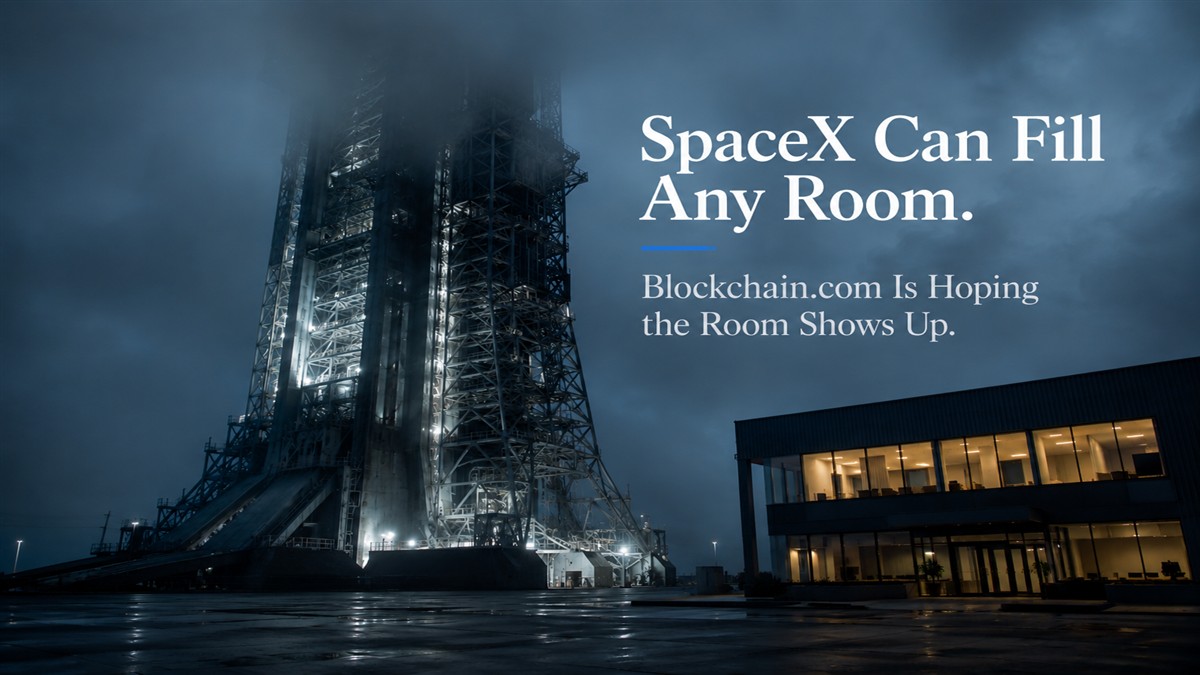
Two companies. Two IPOs. One has institutions fighting over allocation. The other is quietly praying the window doesn't close first.
I've been watching this unfold for a few weeks, and the contrast between SpaceX and Blockchain.com is more instructive than either story on its own.
Let's start with the rocket.
SpaceX at $1.75Tn, When Demand Is Effectively Unlimited
SpaceX filed its S-1 on May 20 targeting a $1.75Tn valuation (larger than Microsoft, trailing only Apple and Nvidia) with a Nasdaq debut set for June 12 under the ticker SPCX and a planned raise of up to $75Bn, which would be the largest IPO ever recorded (Fortune, May 2026). The market appetite is, for all practical purposes, unlimited, Starlink's revenue trajectory ($11.4Bn in 2025, 61% of total revenue), the Mars settlement narrative, the brand. Institutional capital from sovereign wealth funds to growth-stage allocators is queuing up hungrily.
But even more interesting than the IPO itself is what happens to the thousands of investors currently holding tokenized SpaceX exposure through platforms like Republic and various offshore venues. Synthetic instruments, pre-IPO wrapping structures, perpetual futures priced off secondary market transactions.
When SpaceX lands (upright, like its rockets) on a public exchange, what exactly do those holders own?
The Tokenization Stress Test Nobody Noticed Has Already Started
That depends entirely on how well the platforms engineered their settlement mechanics. Some will convert cleanly into actual SpaceX equity or a fair cash equivalent. Others will settle in cash at prices that diverge, sometimes uncomfortably, from what investors thought they were buying.
There's also a premium problem. Tokenized private market exposure was always partly a story about access, for investors who couldn't get into the Series round, who wanted the SpaceX narrative without the institutional roadblocks. That access premium gets priced in. Anyone who bought in at 15–20% above prevailing secondary market prices will be comparing their cost basis to the IPO price on Day 1. That's a conversation some platforms haven't fully prepared their users for.
And then there's the regulatory question that was always deferred. The "is this actually a security?" test was never resolved, just postponed. It becomes a lot harder to ignore when the underlying company is filing an S-1.
I keep coming back to the stakes of how this resolves. If settlement is clean (holders end up with real shares or a genuinely fair cash equivalent) it validates the on-chain private market thesis in a way that no whitepaper ever could. If it's messy, with price discrepancies, regulatory challenges, platform failures, the damage won't be contained to SpaceX tokenholders. It'll ripple into every serious institutional conversation about tokenizing private assets going forward.
Real-world asset tokenization has genuine momentum right now, as I explored in the 1996 internet framing. A high-profile blowup in the most visible pre-IPO token would set that narrative back considerably. We're running a live stress test on every tokenized private market thesis, and most people haven't noticed we're already in the middle of it.
The Crypto Derivatives Angle
The perp futures story is a quieter version of the same problem. Perpetual futures on SpaceX equity have existed on various offshore venues, structured in ways that made compliance teams simultaneously nervous and intrigued. Once SpaceX trades publicly, those instruments get made redundant by regulated options and futures markets almost overnight. The crypto-native venues that built around them will need to find a new value proposition quickly.
This is a pattern worth watching, the regulatory question that crypto keeps deferring eventually gets forced by an event, not a rule. SpaceX going public is that forcing function for a whole category of synthetic private-market exposure products.
Blockchain.com's Harder Road
Now, Blockchain.com, which filed confidentially with the SEC on May 21 (CoinDesk, May 2026), is heading toward a very different market.
Coinbase has been public since 2021. It's been through its seasons, falling from a $100Bn direct listing valuation to around $8Bn at the cycle bottom before climbing back. The institutional investor who wants managed crypto exchange exposure already has a vehicle, a track record, and a set of quarterly reports to read.
The broader IPO window for crypto has mostly closed. Kraken's parent Payward paused its listing earlier this year and then cut 150 jobs in May (CoinDesk, May 2026). Ledger paused its US listing days later, citing market conditions (CoinDesk, May 2026). BitGo did list, pricing at $18 a share in January (Bloomberg, January 2026), but BTGO now trades around $7, more than 60% below its IPO price.
Blockchain.com will need to make a genuinely differentiated case. Not just from Coinbase, but from Kraken, which moved then paused its march toward public markets. "Another crypto exchange IPO" is not an easy pitch in a room full of allocators who've already done the analysis once and, for many, have the scars to show for it.
A Smaller Pool, a Tougher Pitch
There's plenty of capital in the system, but it isn't distributed evenly. The money chasing SpaceX comes from crossover funds, sovereign wealth vehicles, and growth-stage allocators with broad mandates. The money that would naturally find Blockchain.com sits in a much smaller pool, crypto-specialist funds, tech growth investors with digital asset exposure targets. That pool isn't dry, but it isn't bottomless either.
The irony is real. Blockchain.com has done as much as any platform to put crypto wallets in the hands of mainstream users. As a true crypto OG, that's a genuine legacy. But first-mover credibility doesn't always translate to public market premium when the sector thesis has already been priced in via someone else.
The timing question is genuinely hard to read from the outside. Is this a strategic choice, believing the window will widen further? Or is it "the window is as good as it's going to get, so let's go"? Both are plausible. Only one is the reason they'll give in the roadshow.
Three Questions I Can't Resolve Yet
Will the SpaceX IPO trigger a proper regulatory reckoning for tokenized private market platforms? Not punitive, but the clarification the industry has actually needed for three years. The S-1 filing makes the deferral harder to sustain. Similar dynamics are already playing out across DeFi infrastructure, the question that was easy to defer at small scale becomes load-bearing at institutional scale.
Is Blockchain.com's timing a strategic choice, or a forced hand? The answer matters because it signals how much runway the company believes it has to operate as a private company and whether this IPO is about growth capital or something else.
If you're holding tokenized SpaceX on any platform, have you actually read the settlement mechanics? Not the marketing. The mechanics. Do you know what you own? What price you'll receive? What the platform's regulatory standing is if the SEC decides to weigh in after the S-1 drops? These aren't hypothetical questions anymore. They're live.
The SpaceX IPO will be celebrated as a triumph of American innovation and private capital markets. It might also, quietly, be the moment that forces the tokenized private markets industry to grow up. The two things can both be true.
