Risk, Security & Self-Custody

Where digital-asset systems actually break: bridges, exploits, key management, and the hard edges of holding your own assets.

Most digital-asset losses are not exotic cryptography failures. They trace back to who holds the keys, who can approve a transfer, and which price a contract chooses to trust. These pieces follow that pattern from bridges and oracles to inheritance, alongside the bridge exploit database and the self-custody guide.

Articles in this theme

An antique brass beam balance with two empty pans hanging slightly out of level
· 11 min read

Who Decides What a Price Is. Your Oracle Already Chose.

A price looks like a fact and behaves like a decision. Every oracle picks which venues count, over what window, combined by what method, and whose key may sign the result, and each of those choices has already cost DeFi real money. LIBOR and the 4pm London fix taught traditional finance the same lesson twice, for more than $13Bn in fines. The losses have now moved from manipulated math to compromised authority, with roughly $972MM gone across 207 incidents in the first half of 2026.

Read article →

Teenage son leaning on his father's shoulder looking at a phone in a softly lit living room
· 13 min read

Self-Custody Has No Answer for Incapacity

Self-custody assumes you will be alive and lucid every day you hold the asset, and that assumption quietly fails the moment a stroke, dementia, or a lost seed phrase enters the picture. An estimated 20% of all Bitcoin, around 3.7 million coins worth well over $200Bn, sits permanently unreachable, and most of that loss traces to death and forgetting rather than theft. The crypto orthodoxy built a system that punishes the elderly, the sick, and the heirs who never asked to learn cryptography. The part of this industry actually engineered for a human lifespan turns out to be the custodian everyone was taught to distrust.

Read article →
Dark suspension bridge at dusk against a stormy sky, dramatic cinematic lighting
· 15 min read

The Keys Were Always the Weakest Link. Crypto Still Hasn't Fixed It.

Gravity Bridge lost $5.4MM on May 30 through a suspected signing key compromise, the latest in eight bridge exploits that cost the crypto ecosystem $328.6MM in a single month. The root cause is not new code vulnerabilities. It is the same concentrated signing authority problem that traditional finance spent fifty years learning to control through hardware security modules and dual-authorization requirements. The industry keeps paying the tuition. It has not yet taken the course.

Read article →
Abstract digital bridges connecting multiple blockchain networks visualized as glowing chains in deep navy
· 7 min read

Cross-Chain Bridges: The CDOs of DeFi?

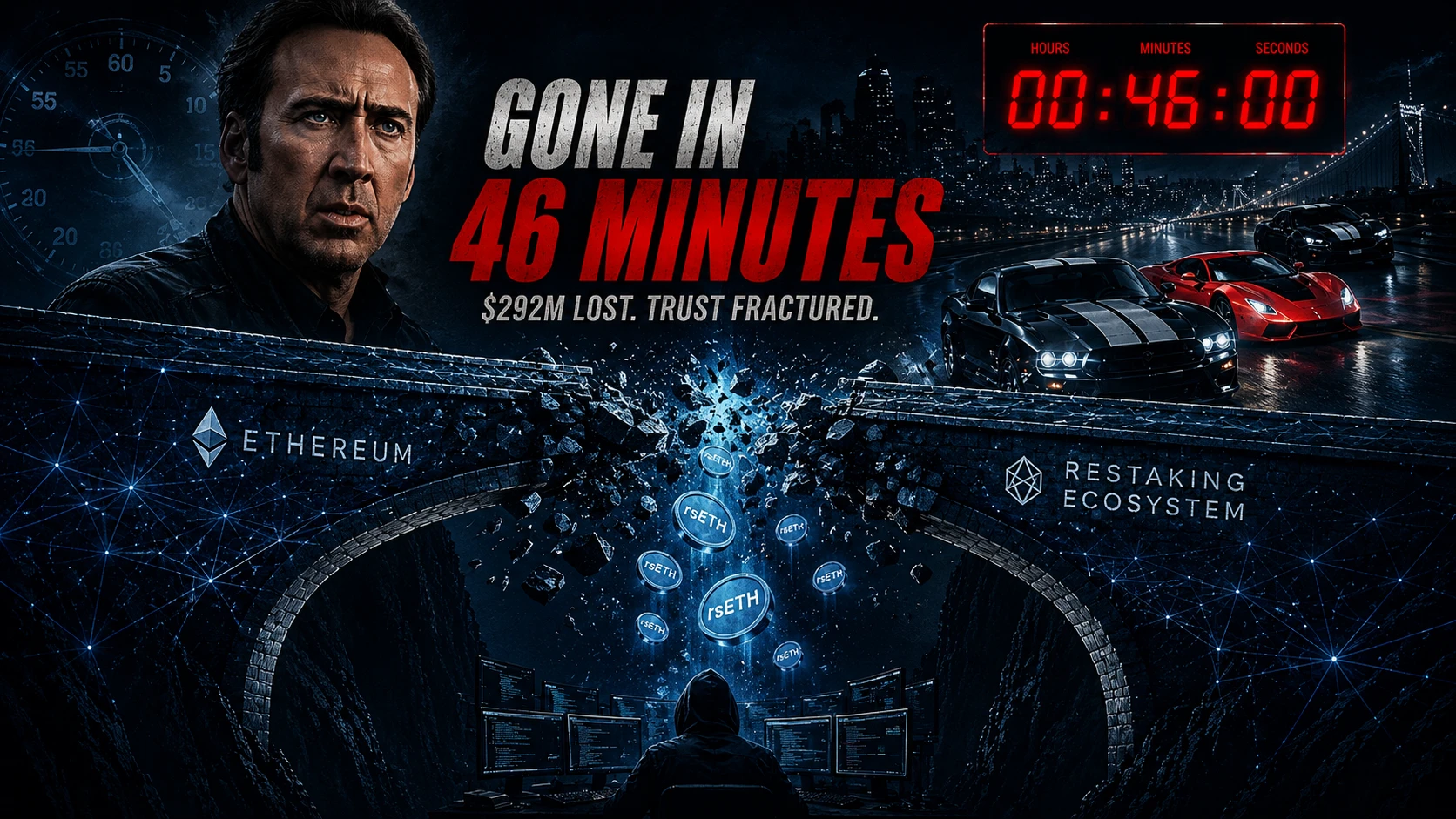
Two cross-chain exploits in one news cycle, $292MM from KelpDAO, $10.8MM from Thorchain, triggered $4Bn in asset migrations and exposed a textbook concentration risk that was hiding in plain sight. DeFi built interconnected financial infrastructure at scale without anyone running a counterparty exposure report; TradFi learned that lesson in 2008, and the cost of relearning it tends to compound. Whether the exodus is a market correctly repricing risk or the first leg of a longer unwind is the question DeFi hasn't yet answered.

Read article →