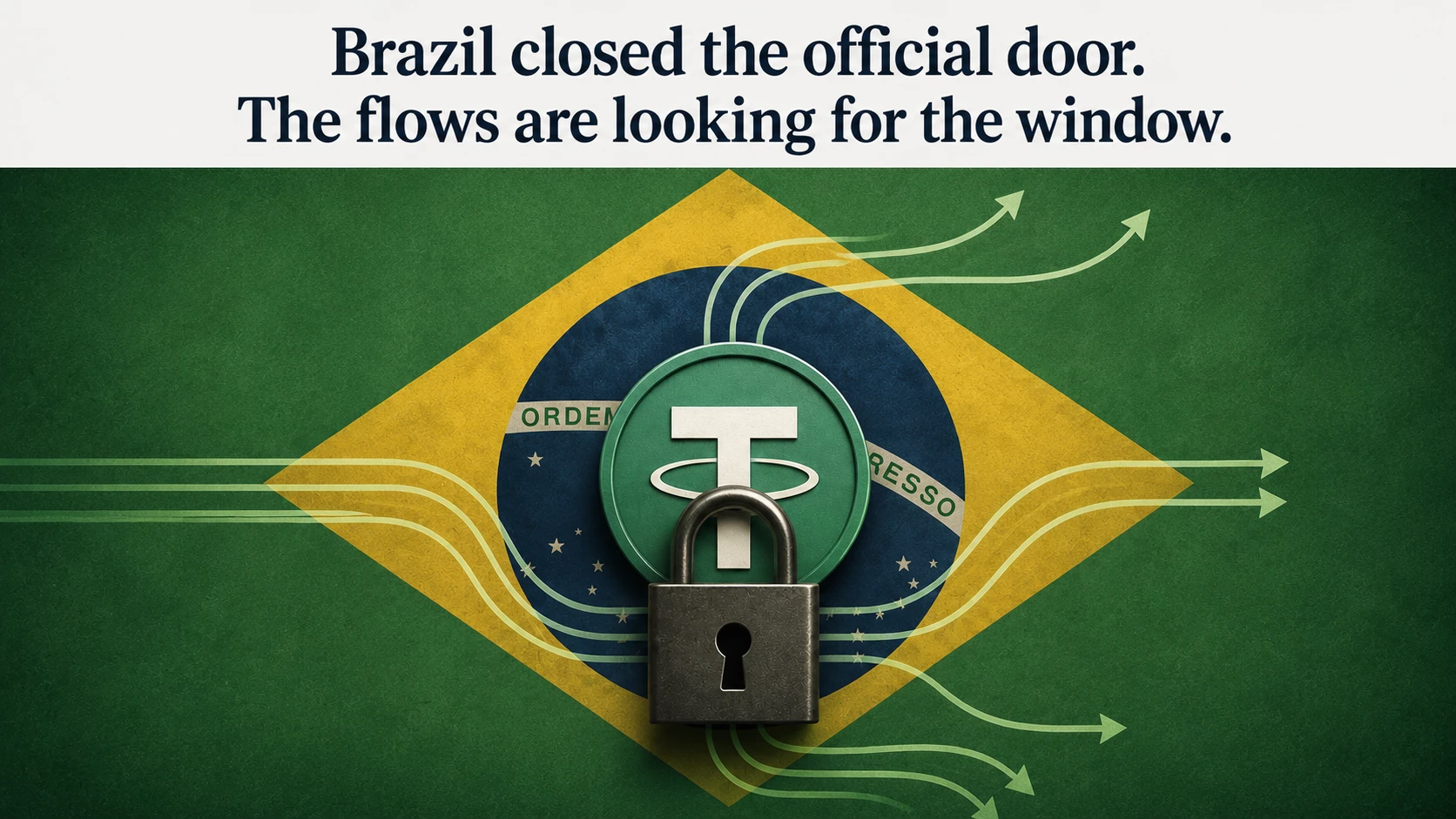
I can think of a Brazilian reasons why this isn't a great idea ...
On April 30th, Brazil's Central Bank (BCB) published Resolution 561 (CoinDesk, May 2026). This bars stablecoins and other crypto assets from being used to settle payments inside the regulated eFX system, Brazil's official cross-border payment infrastructure. On a phased basis, starting October 1st, fintechs and payment firms like Nomad and Braza Bank must use fiat-only settlement on that rail.
Tellingly, stablecoins already account for roughly 90% of reported crypto-linked international transfers from Brazil (CoinDesk, November 2025). That's the volume now being pushed off the official rails.
If it's worked so well, why stop it? Because compliance may not have kept up with the growth, or the BCB was concerned about local currency sovereignty.
What the eFX System Actually Is
The eFX system is Brazil's regulated foreign exchange electronic infrastructure, the official plumbing through which fintechs legally report and settle cross-border transactions. Think of it as the supervised highway for moving money in and out of Brazil. When you're on the eFX rail, the BCB has visibility, volumes, counterparties, flows, the works. The data goes into the regulator's dashboards. Auditors can follow it.
When you're off the eFX rail, you're operating in a less supervised space. Not necessarily illegal, but the BCB's line of sight gets considerably shorter.
That distinction matters enormously. Resolution 561 doesn't make stablecoin cross-border flows illegal. It makes them invisible to the system the BCB actually controls. That's a very different regulatory outcome than it might appear on the surface.
Why 90% Is Such a Striking Number
Let's sit with that figure for a moment. Stablecoins account for roughly 90% of reported crypto-linked international transfers from Brazil. That's not a niche use case. That's not a corner of the market that got a little enthusiastic. Stablecoins became the dominant mechanism for cross-border crypto settlement in Brazil, and they did it organically, without any government mandate, because they were solving a real problem.
Brazil has a persistent informal dollar economy that predates digital assets by decades. The BRL depreciates frequently and sometimes sharply against the dollar. Cross-border remittances through traditional banking channels are expensive and slow. USDT and USDC offer a fast, cheap alternative that ordinary Brazilians, sending money to relatives abroad, paying international freelancers, protecting savings from BRL volatility, actually found useful.
Stablecoins didn't create that demand. They partially formalized it. They brought some of an existing informal flow onto regulated infrastructure where it could be reported and monitored. The Augustus bank charter shows what stablecoin-native settlement infrastructure looks like when it's built for institutional scale from day one, not retrofitted onto legacy rails.
Resolution 561 is now reversing that formalization.
We've Seen This Script Before, and Also What Comes Next
In Malaysia in 2021, the Securities Commission required crypto trading platforms to register, which tightened the regulated environment and pushed some volume toward unlicensed offshore operators. Reported domestic crypto settlement dropped in the following two quarters. But on-chain data told a different story, wallets continued transacting, just through different routes. The regulatory pressure changed the reporting picture. It didn't change the demand picture.
India's post-UPI period showed the same pattern. When India's Unified Payments Interface scaled and regulators periodically clamped down on crypto payment rails, informal P2P stablecoin flows didn't disappear. They continued through Telegram groups, local exchanges, and OTC desks. Users adapted. Capital found its route. The government got a cleaner audit surface on a smaller slice of what was actually happening.
The BCB resolution gives regulators visibility and control over the infrastructure they supervise. However, it doesn't automatically give them control over capital that will now find an alternative route.
That's not a criticism of the BCB. It's just an accurate description of what this kind of rule achieves, and what it doesn't.
What Firms Like Nomad and Braza Bank Actually Face
For regulated fintechs, the path is clear and non-negotiable. Nomad, Braza Bank, and any firm operating with an eFX license has to comply. Compliance isn't optional when your regulatory license depends on it. So by October 1st, these firms will have switched to fiat-only settlement on the eFX rail. Their operations will be clean and auditable.
But here's the part that doesn't resolve cleanly, the demand their users have for dollar-denominated settlement doesn't disappear along with the stablecoin option. Brazilian users who want to hold USDT, send USDC internationally, or move value without BRL volatility exposure will still want to do those things. If the regulated fintech channel closes, they look for the next option, offshore exchanges, P2P platforms, OTC desks, informal networks.
The firms operating cleanly get a simpler compliance environment. The users who want dollar exposure find a different door. Neither outcome is wrong, exactly. But neither outcome represents the BCB gaining actual control over the flows it's concerned about.
Currency Sovereignty and What the BCB Is Really Protecting
There's a genuine policy logic behind Resolution 561 that deserves fair treatment, even if I think the practical outcome is messier than the rule suggests.
Large-scale stablecoin adoption in cross-border payments is, functionally, partial dollarization of a key economic segment. When 90% of your crypto cross-border volume runs through dollar-pegged assets, you have a significant slice of your economy effectively operating outside the BRL. Central banks everywhere are sensitive to this, not just the BCB. It's one of the core anxieties behind every major central bank's CBDC program.
The BCB is also dealing with a compliance gap. The growth in stablecoin eFX volume was fast. Fast growth often outpaces the compliance frameworks that were designed for slower growth. It's entirely plausible that the BCB looked at that 90% figure, looked at its compliance infrastructure, and concluded the gap had gotten too wide to manage within the existing rules. Sometimes the most straightforward regulatory move is to push the non-compliant volume off the supervised rail and deal with what remains.
That's a coherent position. It's also a position that trades audit clarity on a smaller pool for reduced visibility into a larger one.
Audit Clarity vs. Actual Control
This is the distinction I keep coming back to. They are genuinely different things, and conflating them leads to bad policy outcomes.
Firms operating in Brazil now have a clear rule, no stablecoins in the eFX platform after October 1st. Regulators have a cleaner audit surface too. Yet neither outcome resolves where that 90% volume will go. It almost certainly doesn't vanish. It relocates.
If even half of that volume moves to less supervised channels, the BCB has traded a compliance-heavy but visible market for a smaller visible market sitting alongside a larger invisible one. Whether that trade-off is worth it depends entirely on what the BCB was actually trying to achieve.
If the goal was to reduce dollar exposure in regulated cross-border settlement, that works.
If the goal was to reduce total dollar-denominated cross-border flows from Brazil, this won't do that.
Brazil has an informal dollar economy that predates digital assets by decades. Stablecoins didn't create that demand. They partially formalized it. Removing them from official rails doesn't remove the demand. It just decides whether that demand is visible in the data or not.
The BCB is not the only central bank watching this. Every regulator sitting on large stablecoin cross-border flows is running the same risk calculus, do we maintain oversight over a messy but visible market, or do we push it off regulated rails and lose the data? Fink's 1996 internet framing applies here too, the direction is set, but the specific mechanisms that survive are still being selected. The answer determines whether financial regulators are ahead of capital flows or behind them.
What I don't know yet is whether the BCB modeled the behavioral response before publishing Resolution 561, or whether the 90% figure simply became too politically uncomfortable to leave in place. Either is plausible. One of them leads to better policy than the other.
Is this a model other central banks will follow? And if so, are they ready for what comes next?
